Simple motors and generators

This workshop is a fun way for school age students to learn about the history and structure of electric motors and generators. The curriculum included in this document is suitable for two-hour workshop with grades 6-8 participants.
In front of an executive there exist three long tubes (A copper tube, a steel tube and a polyethylene tube). He asks the students to check if the magnet attracts each tube. They do the experiment and their answer is: No. Then the students will be asked to see if the magnet is dropped through the tubes (when they are in a vertical position), is there any difference between the duration time it takes for the magnet to reach on the floor from each tube. They do and see that the duration time for the copper tube is much longer than that of the two others (See figure 1).
Then he explains the reason for this difference in duration and also explains that this is the fundamental of all electric motors and generators.

عكس 1 سناريو موتور
Figure 1) Dropping a magnet through tubes

Then it is explained how the above effect can be used to make electric generators. It is illustrated by using a syringe, an LED, a magnet and copper wires (Figure 2). However, it is mentioned that when the electric generator was invented, there was no LED! The students themselves also try the syringe generator.

عكس 2 سناريو موتور
Figure 2) A simple generator

In an opposite form they also make a simple electric motor as shown in figure 3.

عكس3 سناريو موتور
Figure 3) A simple electric motor

At this point, the instructions and the required basis are given to each group of participants to complete the build of an insect robot. (Students can work in groups of 2 on each robot). A small electric motor makes the fundamental of it. Figure 4 shows the needed steps for building the insect robot.

robot
(a
robot2
(b
robot3
(c
robot4
(d
(e
(f
(g
(h
(i
(j

Figure 4) Insect Robot Assembly Instructions

Explanations of each part of the figure are:
a) This is what you should have in front of you.
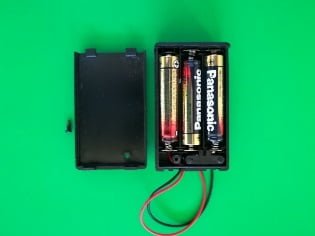
b) Put batteries inside the battery holder.
c) Remove the protection covers of self adhesive tape parts and stick one of them on the platrform and the other on the battery holder.
d) Become ready to connect the middle legs of the insect.
e) Connect the middle legs (Using the provided screws and nuts) and become ready to connect the rear and front legs.
f) Connect the rear and front legs (Using the provided nuts).
g) In connecting rear and front legs, leave 1 mm space between the nut and the cube.
h) Become ready to connect the leg connectors.
i) Note: This step must be done under supervision. Connect the leg connectors like image below and place blue stoppers to prevent wires from slipping out. Ensure that long leg connector is on the inside of the near middle leg. All neighbor stoppers should have a gap of 2 mm.
j) Put the battery holder in its correct position and connect red and black wires onto the gold rings on the motor like below. Intertwine the copper wires into the rings.
After step j the supervisor will fix the nuts on rear and front legs by using a hot glue gun or other kinds of adhesives and will do a final checkout. Figure 6 shows the sequential steps to complete the insect robot. While participants are working on the robots, graduate and undergraduate student volunteers can superwise the progress of each group and help them with their questions and adjusting the parts to improve the operation of their robots. Depending on the age of the participants and duration of the workshop, extra materials can be provided for students to decorate their insect robots (Figure 5).

IMG_2123-3.jpg
Figure 6) Details of robot assembling

Finally, with their robots, the students can participate in a race which is a fun way to see their creations in action!

aa
a)
b)
c)
d)
e)
f)

Figure 6) Details of robot assembling

Share it in social media